How to Increase Work Efficiency: A Workspace-First Guide for Malaysian Professionals
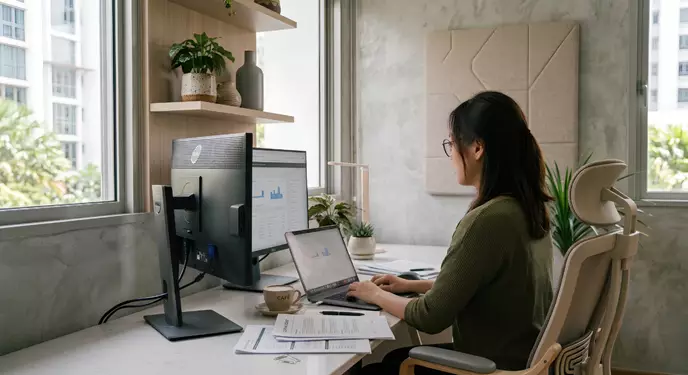
Most advice on getting more done starts with your habits, your calendar, or the latest app. That matters, but it skips the thing sitting right in front of you: where you actually work. A professional in Kuala Lumpur juggling client calls from a noisy kitchen table faces a very different set of obstacles from someone with a quiet, dedicated desk, even when both follow the same to-do list.
This guide takes a practical view of how to increase work efficiency, with equal attention to the methods that help you focus and the environment that lets those methods stick. It is written for freelancers, small business owners, and remote or hybrid workers in Malaysia who want steadier output without simply adding hours to the day. The techniques are simple to adopt. The harder part, as most people discover, is protecting the conditions that make them work.
What Work Efficiency Really Means
Work efficiency is a measure of how much useful output you produce from the time, energy, and resources you put in. Working efficiently means completing quality work with less wasted effort, rather than staying at your desk longer. It is closely related to productivity, though the two are not identical. Productivity looks at how much you produce. Efficiency looks at how cleanly you produce it, with fewer wasted steps, fewer interruptions, and less rework.
The distinction matters because it changes what you optimise. Chasing raw productivity often leads to longer days and quiet burnout. Improving efficiency instead asks a more useful question: where is my time actually going, and how much of it turns into meaningful results? For a small team, small gains compound quickly. Trimming even thirty minutes of daily friction per person returns several working days across a month, time that can go toward clients, growth, or simply finishing at a reasonable hour.
The Habits and Methods That Move the Needle
No single technique fixes a scattered workday. A handful used consistently, however, will noticeably change how much you get through. The following approaches tend to survive contact with a busy schedule.
1. Set Clear Priorities Before You Open Your Laptop
Efficiency starts with deciding what deserves your attention. Setting a few specific, measurable goals for the day keeps you from drifting into low-value busywork. Many people find it helpful to identify two or three tasks that genuinely move a project forward, then schedule them into fixed blocks of time. This practice, often called time blocking, reserves your sharpest hours for the work that matters most and leaves shallow tasks for the natural dips in your energy.
2. Batch Similar Tasks and Protect Deep-Work Blocks
Switching between unrelated tasks carries a hidden cost. Every time you switch from writing a proposal to responding to a message, your attention needs time to reset. Grouping similar tasks, such as handling all your emails in two or three set windows rather than reacting to each as it arrives, reduces that context switching. Pair this with protected periods of deep work, where notifications are silenced and the door is closed, and concentration-heavy tasks move far faster.
3. Automate and Delegate the Repetitive Work
Much of a working week is spent on tasks that repeat: invoicing, scheduling, data entry, routine follow-ups. Automating repetitive tasks with simple tools, or delegating them to a colleague or an assistant, frees your attention for work only you can do. The first step is to spend a few days noticing which small jobs quietly consume your time. Once you can see them clearly, most can be templated, scheduled, or handed off.
4. Take Structured Breaks Instead of Pushing Through
Long unbroken stretches at a screen erode focus rather than build output. Short, deliberate breaks restore it. A widely used method is the Pomodoro Technique, which pairs roughly twenty-five minutes of focused work with a five-minute pause. The specific timing matters less than the rhythm. Stepping away from the screen, stretching, or taking a brief walk clears your head and often surfaces the solution you were stuck on.
Why Your Work Environment Decides How Efficient You Can Be
Here is where good methods either take hold or fall apart. It is difficult to concentrate in a cluttered, noisy, or distracting space, and no amount of time blocking survives a household of interruptions. Your surroundings set a ceiling on how efficient you can be, which is why the work environment consistently ranks among the biggest factors affecting output.
For those working from home, the fixes are often physical: a tidy desk, decent lighting, a comfortable chair, and a clear boundary between where you work and where you rest. The trouble is that home rarely offers everything a focused workday needs, especially for client-facing work that calls for quiet, reliable connectivity, and a professional setting. This is where a dedicated workspace becomes a genuine efficiency tool rather than a luxury. Many independent professionals and small teams in Kuala Lumpur use a coworking space in KLCC to gain a distraction-free environment, meeting facilities, and a professional backdrop for calls, without committing to a long lease.
For readers weighing the investment against a home setup, our 2026 guide to coworking space costs in KL breaks down the pricing tiers and what each includes. Having somewhere purpose-built to concentrate can do more for a person's output than any productivity app. Readers evaluating where to base client-facing work can also review our overview of the KLCC business district and what makes it a preferred address for professionals.
The broader point is that efficiency is not only personal discipline. It is discipline supported by the right conditions. When the space around you is built for focus, the habits above stop feeling like a fight.
Common Efficiency Traps to Avoid
Knowing what to stop doing is often as valuable as knowing what to start. A few patterns quietly drain most workdays.
Multitasking is the most common. It feels productive, but splitting attention across several tasks usually means each takes longer and carries more errors. Perfectionism is another. Polishing work well past the point of usefulness delays everything behind it, and progress almost always beats an unreachable standard. Meeting overload deserves scrutiny too, since a calendar packed with low-value calls leaves little room for the focused work that actually creates results.
Digital distraction ties these together. Studies have found it can take up to twenty minutes to fully refocus after a single interruption, so an unmanaged stream of notifications is far more costly than it appears. Finally, unrealistic goals set the whole system up to fail. Targets that ignore how long work genuinely takes lead to rushed output and steady discouragement, both of which pull efficiency down rather than lifting it.
Final Thoughts
Increasing how much you get done is rarely about working harder or squeezing more hours from an already full day. It comes from a small set of reliable methods, prioritising clearly, batching similar work, automating the routine, and resting deliberately, supported by an environment that lets those methods hold. For professionals and small teams in Malaysia, the environment piece is often the missing half. Sorting out where you work, whether that is a sharper home setup or a dedicated professional space, tends to produce the gains that technique alone cannot. Start with one change this week, keep what earns its place, and let the results guide the rest.
Contact Us
If you’ve got any questions call us 03 2169 6199 or fill in your information below and we’ll get back to you shortly.